
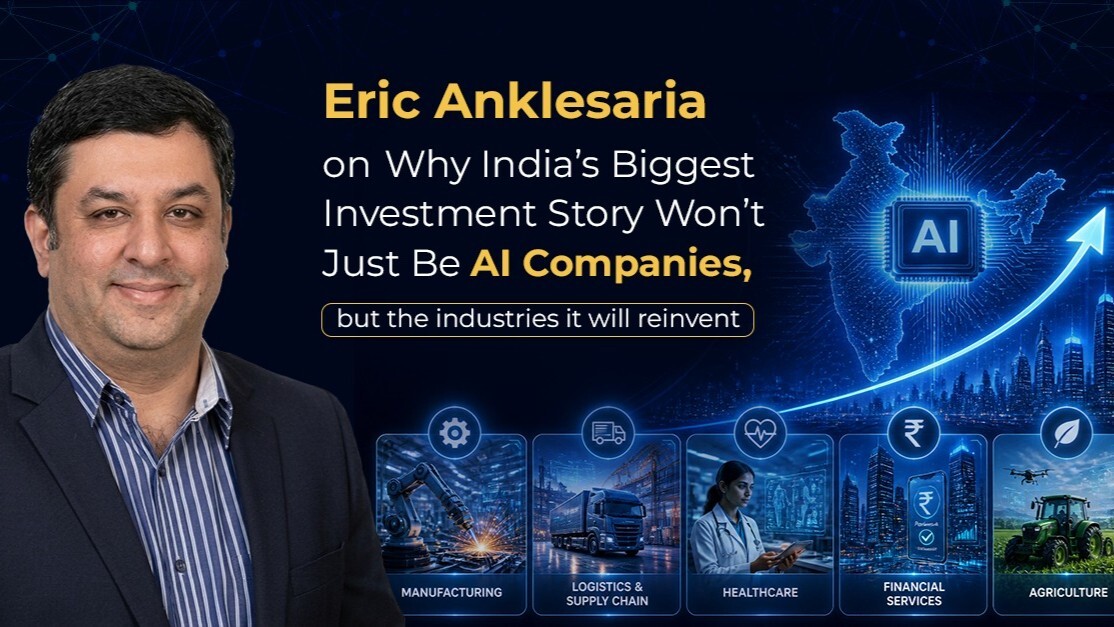
Every technological revolution arrives wrapped in hype. Headlines focus on breakthrough products, soaring valuations, and the race to build the next big platform. Artificial Intelligence is no different. Investors are rushing towards AI startups, semiconductor companies, large language models, and computing infrastructure, hoping to identify tomorrow’s market leaders.
But history reminds us that the biggest fortunes are rarely created by the technology alone. They are created by the industries that learn how to use that technology better than everyone else.
I believe this is where India’s next growth story truly begins.
The real AI dividend will not belong only to companies building AI. It will increasingly belong to the sectors that quietly integrate it into everyday decision-making, improve productivity, and create better customer experiences.
The Real Opportunity Lies Beyond AI Companies
Much of today’s conversation revolves around investing directly in artificial intelligence. While that excitement is understandable, it also risks narrowing our perspective.
Every major technological shift has eventually become infrastructure rather than a standalone industry. Electricity transformed manufacturing. The internet reshaped commerce. Smartphones changed communication. Their greatest impact wasn’t the technology itself. It was the businesses that learned to build on top of it.
AI is beginning to follow the same path.
The question for investors is gradually shifting from “Who is building AI?” to “Who is becoming stronger because of AI?”
That subtle difference may define the next decade of wealth creation.
Banking Is Quietly Becoming Smarter
Few sectors illustrate this transformation better than financial services.
For decades, banks relied on rigid underwriting models, historical data, and standardised risk frameworks. Those systems created consistency, but they also left little room for context.
AI is beginning to change that.
Credit assessment is becoming more dynamic. Fraud detection is becoming increasingly predictive rather than reactive. Customer service is becoming personalised at scale, while operational processes are becoming faster and more efficient.
To me, technology delivers its greatest value when customers stop noticing the technology itself and simply experience a better outcome.
That is exactly where banking appears to be heading.
Healthcare Is Enhancing Human Expertise
Healthcare presents another compelling example.
AI is helping clinicians identify diseases earlier, support diagnostic decisions, optimise hospital operations, and accelerate drug discovery.
What makes this particularly important is that AI is not replacing doctors. It is strengthening their ability to make faster, more informed decisions.
When technology enhances expertise rather than attempting to replace it, both professionals and patients benefit.
That is the kind of transformation that creates lasting value.
Manufacturing Is Becoming More Intelligent
India’s manufacturing ambitions will ultimately depend on far more than production capacity.
Quality, efficiency, resilience, and speed will increasingly determine competitiveness.
AI is already supporting this transition through predictive maintenance, intelligent quality control, digital twins, and smarter supply chains that reduce downtime, minimise waste, and optimise production.
The factories of tomorrow will not simply produce more.
They will produce smarter.
Agriculture Is Becoming More Data-Driven
Perhaps the most encouraging transformation is taking place within one of India’s oldest industries.
Satellite imagery, weather intelligence, precision farming, and crop analytics are enabling farmers to make better decisions while using fewer resources.
For a country where agriculture continues to support millions of livelihoods, even incremental improvements in productivity can create meaningful economic impact.
Sometimes the most important innovations are not the loudest.
They are simply the most useful.
The Investment Thesis Is Quietly Changing
This is precisely where I believe investors should focus their attention.
The real opportunity does not lie in chasing every AI headline.
It lies in identifying industries that become more productive, more resilient, and more competitive because artificial intelligence has become embedded within their operations.
These businesses may never describe themselves as AI companies.
Yet they may ultimately become some of the largest beneficiaries of AI.
From Technology to Infrastructure
History follows familiar patterns.
Electricity was once considered an industry before it became infrastructure.
The internet was once a destination before it became invisible.
Artificial intelligence appears to be following the same trajectory.
As AI becomes embedded across business operations, competitive advantage will increasingly come from integration rather than ownership.
Success will belong not only to those who build the technology, but also to those who know how to apply it.
Looking Beyond the Hype
For investors, this requires a subtle but meaningful shift in thinking.
Instead of asking, “Which AI company should I invest in?”, perhaps the better question is, “Which industries will become fundamentally stronger because AI becomes part of their DNA?”
I believe that is where the next chapter of value creation will unfold.
Because the greatest AI winners may not be the companies building artificial intelligence.
They may be the businesses quietly learning how to think differently because of it.